
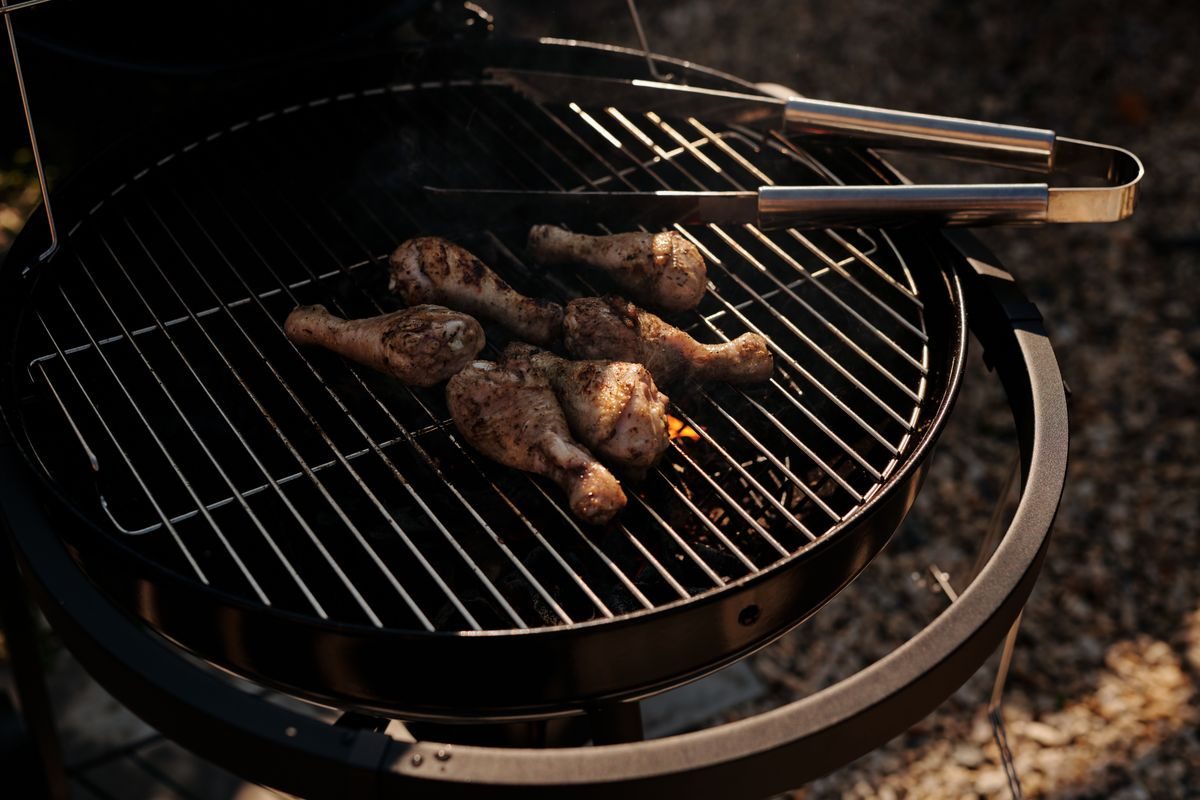
This recipe is taken directly from Weber’s official recipe library — the Grilled Chicken Drumsticks recipe published on weber.com. It’s about as bare-bones as grilled chicken gets: four ingredients and one seasoning step. Weber’s site also publishes a second, much slower drumstick recipe worth knowing about, one that changes the shape of the cut entirely, so this article walks through both.
Ingredients: The Quick-Grilled Version
- 8 chicken drumsticks
- 1 tablespoon vegetable oil
- 2 teaspoons kosher salt
- 1 teaspoon black pepper
That’s the full list. Weber lists this as serving 4, with a 5-minute prep time and about 20 minutes on the grate.
Method
- Prepare the grill for direct heat: 450-500°F (about 232-260°C) for gas, 400-450°F (about 204-232°C) for charcoal, or a flat 475°F (about 246°C) if your setup doesn’t distinguish between the two. Preheat 15 minutes and brush the grates clean.
- Rub the drumsticks with the oil, then season all over with the salt and pepper.
- Place the drumsticks on the grill, lid closed, and cook 8-10 minutes. Flip and continue cooking until the internal temperature reaches 165°F (74°C), another 8-10 minutes.
- Let the drumsticks rest 5 minutes before serving.
Total grilling time lands around 20 minutes, and Weber’s instructions are explicit that doneness is judged by an instant-read thermometer in the thickest part of the meat, not by the clock.
A Second Method: Turning Drumsticks Into “Lollipops”
Weber also publishes a slower Chicken Drumsticks with Barbecue Sauce recipe built around a butchering technique rather than a quick sear. The instructions call for holding each drumstick by the bone and using a small, sharp knife to cut around the bony end through the skin, meat, and sinew, then pulling or cutting that material away from the base along with the joint, and pushing the remaining meat up toward the top of the bone. The result is a drumstick shaped like a lollipop, with a clean bone handle and a rounded knob of meat at the top.
The 16 trimmed lollipops are rolled in a dry rub — sweet paprika, 1 tablespoon fine sea salt, 1 tablespoon brown sugar, 1 teaspoon dried oregano, 1 teaspoon black pepper, 1 teaspoon chili powder, 1½ teaspoons granulated garlic, and 1½ teaspoons granulated onion — then set meat-side up on a rack or threaded onto metal skewers. Instead of Article 1’s direct high heat, this version grills over indirect medium-low heat, 325-375°F (about 163-191°C) on charcoal or a steady 300°F (about 149°C), lid closed, in four 15-minute rounds, with a brush of ¾ cup barbecue sauce added at each round. Weber puts the total grilling time at roughly an hour, checked the same way as the quick version: an instant-read thermometer in the thickest part of the chicken, not touching the bone, reading 165°F (74°C).
Why the Same Cut Gets Two Very Different Grill Times
Both of Weber’s drumstick recipes finish at the identical internal temperature, but they get there on opposite ends of the clock, about 20 minutes for the direct-heat version against roughly an hour for the lollipop version. The difference comes down to heat placement and repeated basting rather than the meat itself. Direct heat over 450-500°F sears the skin quickly and cooks a bone-in drumstick through in well under half an hour, which is the faster route when you just want dinner on the table. Indirect medium-low heat trades that speed for control: because the meat never sits directly over the flame, there’s room to brush on barbecue sauce four separate times without it scorching or breaking down into a bitter char, which is the point of the slower method in the first place.
Neither recipe treats the clock as the real signal for doneness. Both call for pulling the drumsticks once an instant-read or probe thermometer confirms 165°F (74°C) in the thickest part of the meat, which matches the USDA Food Safety and Inspection Service’s minimum internal temperature for all poultry, including legs, thighs, wings, and whole birds. That figure is listed on FSIS’s own safe temperature chart as 165°F (73.9°C), and it’s worth checking with the bone-in cuts specifically: keep the probe away from the bone itself, since bone conducts heat differently than muscle and can give a falsely high reading.
Which Version to Use
The direct-heat recipe is the one to reach for on a weeknight: four ingredients, one bowl, twenty minutes at the grate. The lollipop version takes real knife work up front and roughly three times the grill time, but it turns a basic drumstick into something closer to a handheld appetizer, with a caramelized barbecue-sauce crust built up over four separate bastings instead of one quick sear. Both are Weber recipes cooked to the same safe endpoint, so the choice really is about how much time and knife work you want to put in before the grill lid closes.
Keep reading
- Weber’s Official Beer Can Chicken Recipe, Step by Step
- Weber’s Harissa Chicken Thighs on the Grill
- Grilled Buffalo Chicken Wings: Weber’s Recipe and Origin
- Weber’s Grilled Cornish Game Hens, Step by Step