
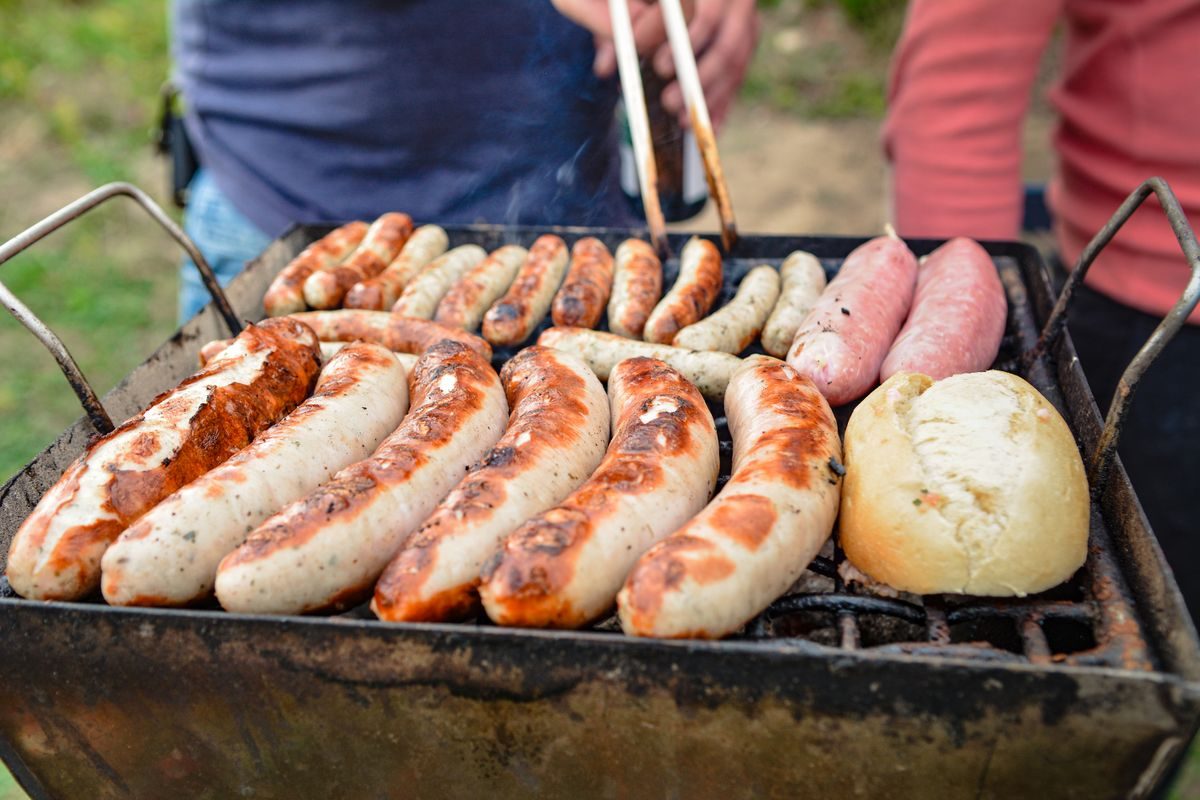
Cooking for twenty people on one grill means the first burgers come off long before the last ones go on. That gap is where food safety quietly slips: cooked food sitting on a counter cools into the range where bacteria multiply. This guide draws on the USDA Food Safety and Inspection Service’s grilling guidance and the FDA’s outdoor food-handling page. It covers staging and timing, not quantities; for how much to buy, see our meat-per-person calculator.
The Two Numbers That Drive Everything
The FDA defines the “Danger Zone” as 40°F to 140°F (4°C to 60°C). Its rule is to never let picnic food stay in that range for more than 2 hours, or 1 hour when the outdoor temperature is above 90°F (32°C). For hot food, the FDA says to keep it at or above 140°F (60°C). USDA says the same for grilled meat and poultry: keep it hot until served, at 140°F or warmer.
The practical reading for a big cookout: every batch has to be either cooked and served quickly, or held at 140°F or above. A pile of burgers cooling on a platter is neither.
Plan the Holding Space Before You Light the Grill
USDA lists the options for keeping cooked meat hot at home:
- the side of the grill rack, away from the coals (not directly over them, where the food could overcook);
- an oven set at approximately 200°F (about 93°C);
- a chafing dish or slow cooker;
- a warming tray.
The FDA adds that hot food carried elsewhere should be wrapped well and placed in an insulated container until serving. Decide which of these you are using, and clear the space, before the first batch comes off.
Stage Batches in Order
Cook to temperature, then hold
Use a food thermometer on every batch, because grilled meat browns fast on the outside. USDA’s minimums: steaks, roasts and chops of beef, pork, veal and lamb to 145°F (63°C) with a 3-minute rest; ground beef, pork, veal and lamb to 160°F (71°C); all poultry, including ground, to 165°F (74°C). Only food that has reached its safe temperature goes to the holding area.
Do not pre-cook and finish later
Staging a big cook does not mean starting food early. USDA’s instruction is direct: never partially grill meat or poultry and finish cooking later. The FDA allows partial cooking only when the food goes straight onto the hot grill afterward. Each batch should go from raw to done in one continuous cook, then into the hot-holding area.
Use a clean platter for every trip
USDA says to use a clean platter when taking food off the grill, never the one that held raw meat or poultry. The FDA advises keeping a clean platter and utensils ready at grill-side. With multiple batches, set out several clean platters in advance so nobody reuses a raw-meat one in a rush.
Watch the Clock on the Serving Table
Once food moves from hot holding to the serving line, the 2-hour limit applies. In hot weather, above 90°F, USDA says food should never sit out for more than 1 hour. Both agencies say food left out longer should be discarded. A workable habit that follows from this: note the time when a dish goes on the table, and put out small amounts at a time, refilling from the hot-holding area, rather than setting out everything at once.
Leftovers After a Long Cookout
The FDA says to refrigerate or freeze perishables within 2 hours, or within 1 hour if it is above 90°F outside. It also recommends dividing large amounts of leftovers into shallow containers so they cool faster. On a long day with a large group, build the clean-up step into the schedule instead of leaving it until everyone has gone home.
A Simple Timeline
- Before lighting: choose and set up your hot-holding method; lay out clean platters and utensils; have a thermometer ready.
- Each batch: cook raw-to-done without interruption, check the temperature, move to hot holding at 140°F or above.
- Serving: bring out small portions and track the 2-hour (or 1-hour above 90°F) limit.
- Afterwards: refrigerate leftovers in shallow containers within the same time limits.
Keep reading
- Tailgate Food Safety: Coolers, Timing, Reheating
- Smoking Meat Safely: A USDA and UK FSA Checklist
- Cooking at the Campsite: USDA Food Safety Guidance for Coolers, Fires and Stoves
- Safe Internal Cooking Temperatures for Grilling and Smoking (USDA Guide)