
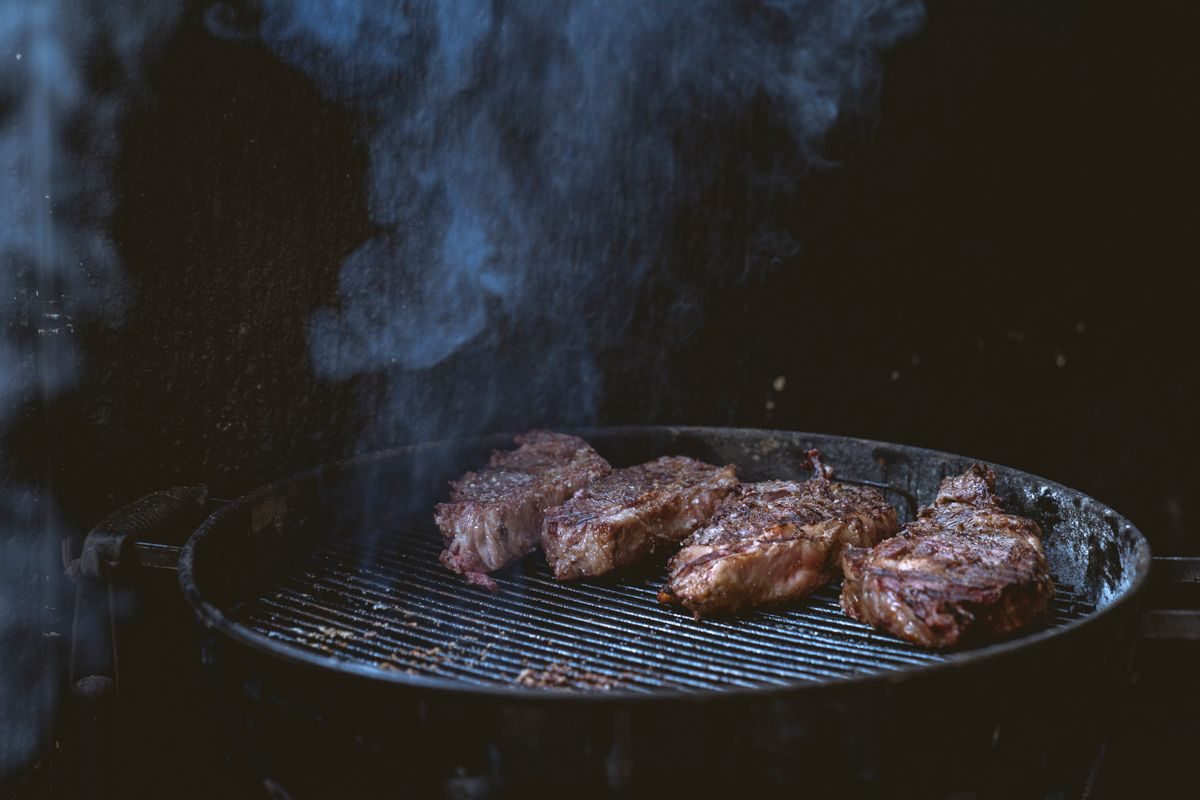
Grilling and smoking both make it easy to judge food by eye, and both make that a risky habit. The USDA’s Food Safety and Inspection Service (FSIS) says a food thermometer is the only reliable way to know meat, poultry, seafood or egg dishes have reached a safe internal temperature. This guide covers the main thermometer styles, where to put the probe, how to check the thermometer itself, and the official numbers to aim for, in both °F and °C.
Why Colour and Clock Don’t Settle It
FSIS says colour changes and firmness are often used to judge whether food is cooked, but neither tells you it is safe. In a USDA study, 21% of participants relied on visual cues such as colour and grill marks to judge their hamburger patties, and FSIS notes that ground beef can turn brown on the outside before it reaches a temperature that destroys harmful bacteria. A hamburger cooked to 160°F (71°C), measured with a food thermometer, is safe regardless of colour.
Time is no better a guide. FSIS points out that the size, quantity and distribution of food on the grill mean individual pieces reach a safe temperature at different times, so every piece needs checking and a large or irregular cut such as a roast should be probed in several places.
Instant-Read, Leave-In and Wireless
Instant-read
These are for a quick check near the end of cooking, then come out. FSIS lists digital thermistor models at roughly 10 seconds per reading and thermocouple models at 2 to 5 seconds, both usable on thin and thick food. Dial instant-read models take 15 to 20 seconds and are not suitable for thin foods unless inserted sideways.
Leave-in probe
A leave-in (or alarm) thermometer keeps its probe in the food on a cable that can be shut in the oven or smoker, and sounds an alert at a temperature you set. ThermoWorks, a thermometer manufacturer, describes the difference as follows: an instant-read lets you check several spots in quick succession, while a leave-in tracks one fixed spot over time, like having both an odometer and a speedometer. FSIS also lists oven-safe dial thermometers as designed to stay in food, but warns that heat conducted along the metal stem can read falsely high.
Wireless and smart
FSIS describes these as probes that stay in the food and send the temperature to a base unit or a phone over Bluetooth or Wi-Fi so you can watch progress without opening the lid. It lists them as usable in ovens, grills and slow cookers and notes they cost more. In America’s Test Kitchen’s testing of remote probe thermometers, the testers reported that real-world signal range differed from advertised specifications, that some Bluetooth models lost their connection at as little as 10 feet, and that dense objects can block the signal.
One safety point applies to all styles. FSIS advises against leaving a food thermometer in food while cooking unless the manufacturer’s instructions say it is built to withstand the heat, and warns that some models have plastic faces that can melt if placed too close to heat.
Where to Put the Probe
- Most cuts: the thickest part of the food, away from bone, fat or gristle.
- Whole poultry: check three places, the innermost part of the thigh, the innermost part of the wing and the thickest part of the breast, avoiding bone.
- Thin foods (patties, sausages, thin chops): insert from the side so the whole sensing area reaches the centre.
Read the manufacturer’s instructions for insertion depth. If there are none, FSIS says to look for a dimple on the stem marking one end of the sensor, and notes that dial thermometers generally need 2 to 3 inches (5 to 7.5 cm) in the food. At the grill, FSIS suggests lifting thin food onto a clean spatula or plate before probing it sideways.
Safe Minimum Temperatures
These are the FSIS minimums for common barbecue foods:
- Beef, pork, veal and lamb steaks, chops and roasts: 145°F (63°C), then rest at least 3 minutes.
- Ground meats: 160°F (71°C).
- All poultry, including whole birds, breasts, thighs, wings and ground poultry: 165°F (74°C).
- Fish and shellfish: 145°F (63°C).
The UK Food Standards Agency expresses the target differently: the middle of the food should reach 70°C (158°F) for 2 minutes, with equivalent time and temperature pairs including 75°C (167°F) for 30 seconds, and it says you need a clean food thermometer to measure this accurately. FSIS adds that cooks may choose higher temperatures for personal preference.
Checking Your Thermometer’s Accuracy
FSIS says most food thermometers read within 2 to 4°F, but only if placed correctly. Its recommended check for most thermometers is an ice-water test:
- Fill a large glass with ice cubes, add drinking water and stir well.
- Immerse the stem at least 2 inches (5 cm), touching neither the sides nor the bottom.
- Wait at least 30 seconds and read it without lifting the stem out. It should show 32°F (0°C).
- If not, adjust as the manufacturer directs; some have a calibration nut or dial. Some models, such as thermometer forks, cannot be calibrated.
ThermoWorks gives a more careful version: fill the vessel to the top with ice (crushed is preferred), add water to about half an inch below the top of the ice, then stir the probe in the middle of the slurry away from the sides and bottom. It warns that a simple cup of ice water can read a dozen or more degrees too warm. FSIS also describes a boiling-water check, which should read 212°F (100°C) at sea level.
Keeping It Clean
FSIS says to wash the thermometer in hot, soapy water before and after each use, by hand, since most models should not be submerged. The FSA likewise says to clean the probe fully after each use to prevent cross-contamination.
Keep reading
- Smoking Meat Safely: A USDA and UK FSA Checklist
- Safe Internal Cooking Temperatures for Grilling and Smoking (USDA Guide)
- Cooking at the Campsite: USDA Food Safety Guidance for Coolers, Fires and Stoves
- Grilling for a Crowd: Safe Staging and Timing
Sources
- Food Thermometers — USDA Food Safety and Inspection Service
- Doneness Versus Safety — USDA Food Safety and Inspection Service
- Cooking your food — UK Food Standards Agency (GOV.UK)
- 4 Steps to Creating a Properly Made Ice Bath — ThermoWorks
- What Kind of Thermometer Do I Need? — ThermoWorks
- Remote Probe Thermometers testing — America’s Test Kitchen