
Pizza oven marketing leans on the word “Neapolitan”, so it helps to read what the official documents actually say. Two matter: the European Union’s Traditional Speciality Guaranteed (TSG) specification for “Pizza Napoletana”, and the International Regulations of the Associazione Verace Pizza Napoletana (AVPN), the Naples-based association that certifies pizzerias. Below is what each says about dough, fermentation, shaping and baking, and where a home pizza oven fits. It is the first article in our Pizza Ovens series.
Two Documents, Two Purposes
The EU specification was entered in the register by Commission Regulation (EU) No 97/2010, with the AVPN and the Associazione Pizzaiuoli Napoletani as applicant groups. The regulation records that the name was registered without reservation of the name, and a 2016 Official Journal notice republishes the same specification. The AVPN’s document is different in kind: the association describes its regulations as the rules for obtaining its collective trade mark, “Verace Pizza Napoletana”, and it checks members against them. Both address professional producers; the EU text describes work done in a continuous cycle on the same commercial premises. Neither is a home recipe.
Dough Ingredients
The EU specification lists the basic raw materials as common wheat flour, brewer’s yeast, drinkable natural water and sea or kitchen salt for the dough. Its worked dough example uses 1 litre of water, 50 to 55 g of sea salt, 3 g of brewer’s yeast and 1.8 kg of flour, with a flour W value of 220 to 380.
The AVPN’s 2024 regulations use the same basic recipe per litre of water with wider ranges: 40 to 60 g of salt, 0.1 to 3 g of fresh brewer’s yeast (dry yeast at one third of that, or sourdough under 10% of the flour), and flour listed as 1,600 to 1,800 depending on absorption. It specifies type 00 or 0 flour with a W value of 250 to 320, says to start with the water, and states that no fat or sugar should ever be added.
Mixing and Fermentation
The EU text describes about 10 minutes adding flour in a mixer plus 20 minutes at low speed, a dough fermentation temperature of 25°C (77°F), a two-hour rest under a damp cloth, hand-shaped balls of 180 to 250 g, and a second rise of four to six hours in containers at room temperature.
The AVPN 2024 document takes a different route: balls of 200 to 280 g, scaled to pizza size, and an overall fermentation of 12 to 24 hours in a proofing box. If a controlled chamber is used, its ideal parameters are 18 to 20°C (64 to 68°F) and 60 to 70% humidity. The summary page on the AVPN website gives a shorter minimum of 8 hours, so its own PDF and web page do not match exactly.
Shaping
Both documents require shaping by hand from the centre outwards, and both prohibit a rolling pin or a mechanical press-type disc machine. The EU text gives a centre thickness of no more than 0.4 cm (about 0.16 in), a 1 to 2 cm rim and a diameter not exceeding 35 cm (about 14 in). The AVPN gives a centre of 0.25 cm (about 0.1 in) with the same 1 to 2 cm rim.
Oven Type, Temperature and Bake Time
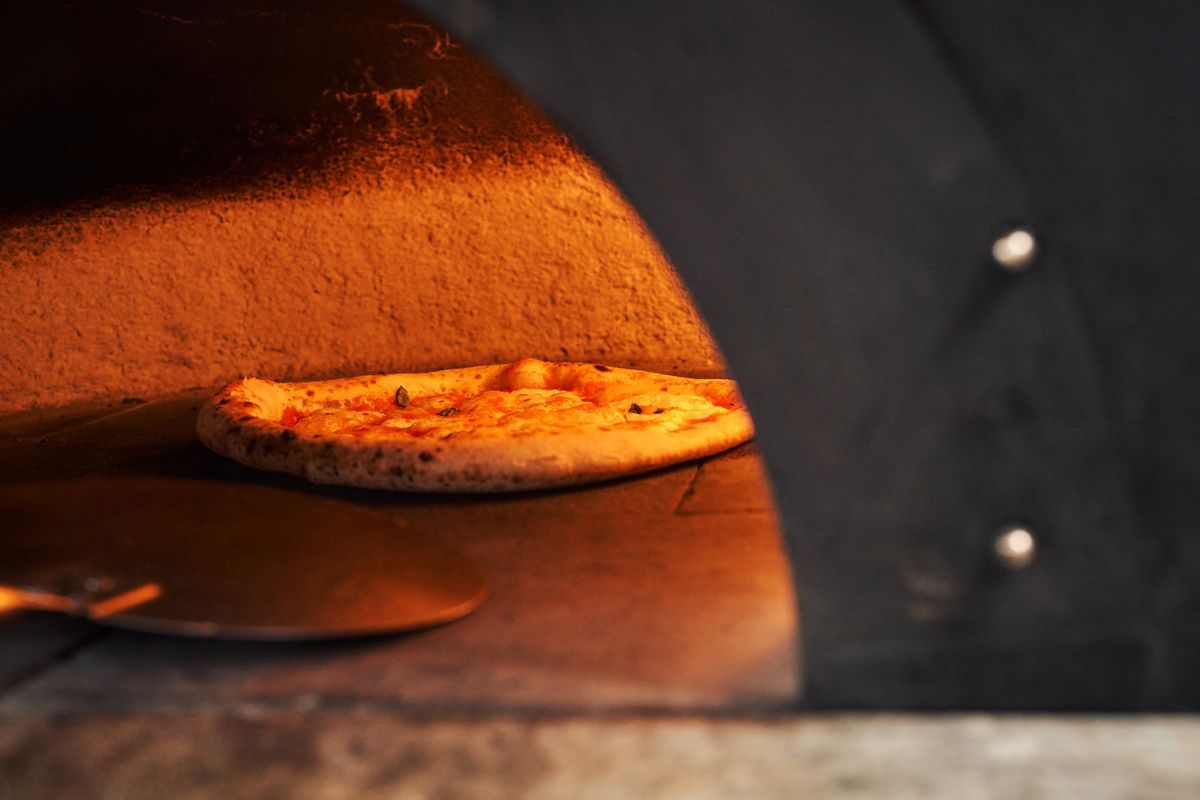
The EU specification says the pizza is baked exclusively in wood-fired ovens at a baking temperature of 485°C (905°F), and its summary lists about 485°C on the cooking floor, about 430°C (806°F) at the dome and a 60 to 90 second bake. The AVPN 2024 regulations give the same time but put the figures the other way round: a base of about 380 to 430°C (716 to 806°F) and a dome of about 485°C (905°F).
The AVPN says the pizza must cook directly on the oven surface, not on a tray. It says cooking was traditionally in wood-fired ovens only, and that gas or electric ovens are now possible if they meet certification parameters approved by the association, with the certification and brand modified to show the difference. It describes a traditional oven floor of 105 to 140 cm (roughly 41 to 55 in) across.
What This Means for a Home Pizza Oven
These documents describe professional production in a particular kind of oven. For a home oven, whatever its fuel, that means a few things.
- The standard is a label, not a benchmark. The EU text requires wood firing, and the AVPN accepts gas or electric ovens only when it has certified them. Neither document certifies home cooking, so “Neapolitan-style” is the accurate description of a pizza from your own oven.
- Heat and time are the hard part. The standards pair a 60 to 90 second bake with floor temperatures from roughly 380°C upward. How close a given oven gets is a question for its manual, not these documents.
- Kitchen ovens work differently. America’s Test Kitchen’s Neapolitan-style recipe (Lan Lam, 2025) heats a baking steel or stone in a home oven to 550°F (288°C), then broils for 4 to 5 minutes. For a pizza oven the same recipe says to heat to 650 to 700°F (343 to 371°C) and bake for 4½ to 5 minutes. Those are that test kitchen’s settings, not the AVPN or EU figures.
- Some habits transfer. Hand shaping without a rolling pin, baking on a hot surface rather than a tray, turning the pizza for an even bake and a long, controlled fermentation all appear in the AVPN text.
Cooking Safely
Fuel-burning ovens produce carbon monoxide. The NHS says carbon monoxide can be made by fires and appliances that burn gas, wood, oil or coal, advises against using a barbecue or camping stove indoors or inside a tent, and recommends a carbon monoxide alarm in rooms with such appliances. It names barbecues and camping stoves specifically; a wood or gas pizza oven burns the same fuels, so treat it the same way and follow the manufacturer’s placement and ventilation instructions.
Keep reading
- How to Preheat an Outdoor Pizza Oven: Ooni’s Method
- Detroit-Style Pan Pizza in an Outdoor Pizza Oven
- How Pellet Grills Make Smoke, and Why It Tastes Lighter
- Santa Maria Tri-Tip: Inside California’s Original Barbecue Tradition
Sources
- Commission Regulation (EU) No 97/2010, Pizza Napoletana (TSG) product specification — EUR-Lex
- Publication pursuant to Article 26(2) of Regulation (EU) No 1151/2012, Pizza Napoletana — EUR-Lex, Official Journal C 176, 2016
- AVPN International Regulations (Disciplinare 2024, English) — Associazione Verace Pizza Napoletana
- AVPN International Regulation summary page — Associazione Verace Pizza Napoletana
- Neapolitan-Style Pizza by Lan Lam — America’s Test Kitchen
- Carbon monoxide poisoning — NHS