
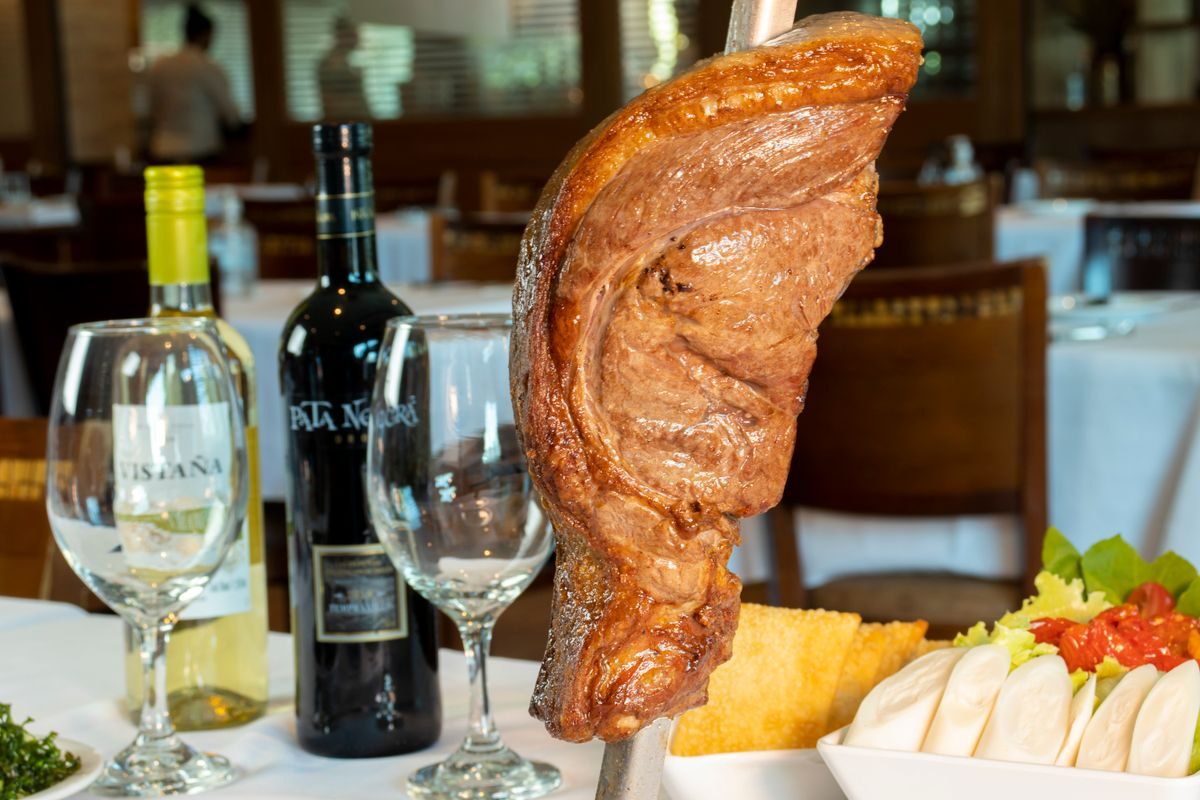
This method is taken from Canal da Receita, a Brazilian recipe site, in Roberta Cadete’s Portuguese-language Picanha na Churrasqueira. We translated the steps and converted the units ourselves, and we compare them with a second Brazilian recipe from the beef producer Sulbeef. Brazilian sources disagree slightly on how to handle the salt, and that is the interesting part.
What picanha is
Brazilian Kitchen Abroad, Aline Shaw’s site devoted to Brazilian cooking, explains that picanha is the Portuguese name for the culotte, a cut from the top sirloin, and that it is typically the star of a Brazilian churrasco. Easy Brazilian Food adds that outside Brazil it may be sold as top sirloin cap, rump cover or rump cap. Canal da Receita describes it as the undisputed queen of the Brazilian barbecue, valued for its generous fat cap.
The fat cap stays on. Shaw’s advice is not to trim it, because that fat carries flavor and silkiness. Canal da Receita adds buying tips: look for an even, white (not yellowish) fat cap and firm, bright red meat.
The sources differ on size. Canal da Receita says a picanha should weigh 1.2 kg (about 2.6 pounds) at most, since larger pieces can include part of another cut. Shaw’s picanha roast post gives a range of 2.5 to 3.5 pounds (1.2 to 1.6 kg). The takeaway is the same in both: an oversized “picanha” may not be the true cut.
Ingredients
- 1 whole picanha, 1 to 1.2 kg (about 2.2 to 2.6 pounds), with a good fat cap
- Sal grosso (Brazilian coarse salt), to taste
- To serve, optionally: farofa, vinagrete, garlic bread or rice
Sal grosso is a large-grained sea salt. Silvio Correa, a Brazilian grill master quoted by Food Republic, says any good coarse salt will do the job if you cannot find it.
The salt approach: three Brazilian views
Canal da Receita seasons with nothing but sal grosso, scattered over every side, and says not to rub it in, only to cover the meat lightly. It also warns against pre-mixed seasonings with high sodium.
Sulbeef’s recipe scores the fat cap in a crosswise pattern, then rubs sal grosso over the whole piece and massages it in. It rests the meat about 5 minutes, warns against leaving it longer because the meat can dry out, then removes the excess salt before grilling.
Correa, quoted by Food Republic, salts “absolutely right before” the meat hits the grill, because salting early draws out moisture. So the point is not a single rule but a small window: coarse salt, applied just before cooking, with the loose excess brushed off if you follow Sulbeef.
Grilling
- Build a strong bed of embers without leaping flames. Canal da Receita’s phrase is brasa forte, mas sem labaredas.
- For a whole piece, start fat side up until it browns, then turn it to crisp the fat. Sulbeef grills its piece about 40 cm (16 inches) above the embers and sears both sides.
- For steaks, slice the picanha 3 to 4 cm (about 1.2 to 1.6 inches) thick, keeping the fat on. Canal da Receita notes that many traditional churrascos cook it this way.
- Canal da Receita’s timing per side: rare 2 to 3 minutes, medium 4 to 5 minutes, and well done 6 to 7 minutes, which it does not recommend for picanha because it loses juiciness.
- Rest 5 minutes, slice against the grain, and avoid piercing the meat during cooking.
For the skewered churrascaria version, Food Republic describes picanha threaded in a folded “C” shape and cooked over flames, and Easy Brazilian Food describes skewering through the fat side, folding, and going back through the other fat side. Neither is required; laying steaks on the grill is fine.
Temperature: Brazilian doneness versus food-safety minimums
Canal da Receita and Sulbeef judge doneness by time and look, not by a thermometer. USDA’s minimum for beef steaks and roasts is 145°F (62.8°C) with a rest of at least 3 minutes, so a rare or medium-rare picanha will finish below that number. UK guidance for businesses says whole cuts of beef and lamb only need the surface sealed, but that minced-meat products need cooking all the way through. Decide which standard you follow, and use a thermometer either way.
Keep reading
- Bulgogi: Maangchi’s Korean Marinated Beef Recipe
- Reverse-Seared Prime Rib: AmazingRibs’ Grill Method
- Meathead’s Brisket Burnt Ends Recipe, Step by Step
- Meathead’s Texas-Style Smoked Brisket Recipe, Step by Step
Sources
- Picanha na Churrasqueira — Canal da Receita, Roberta Cadete
- Picanha na Churrasqueira — Sulbeef
- Picanha Recipe: Brazilian Coulotte Steaks — Brazilian Kitchen Abroad, Aline Shaw
- Picanha Roast — Brazilian Kitchen Abroad, Aline Shaw
- The Simple Yet Elevated Seasoning You’ll Find At Most Brazilian Steakhouses — Food Republic
- Brazilian Picanha Recipe — Easy Brazilian Food
- Safe Minimum Internal Temperature Chart — USDA Food Safety and Inspection Service
- Cooking food safely — GOV.UK food hygiene guidance for businesses