
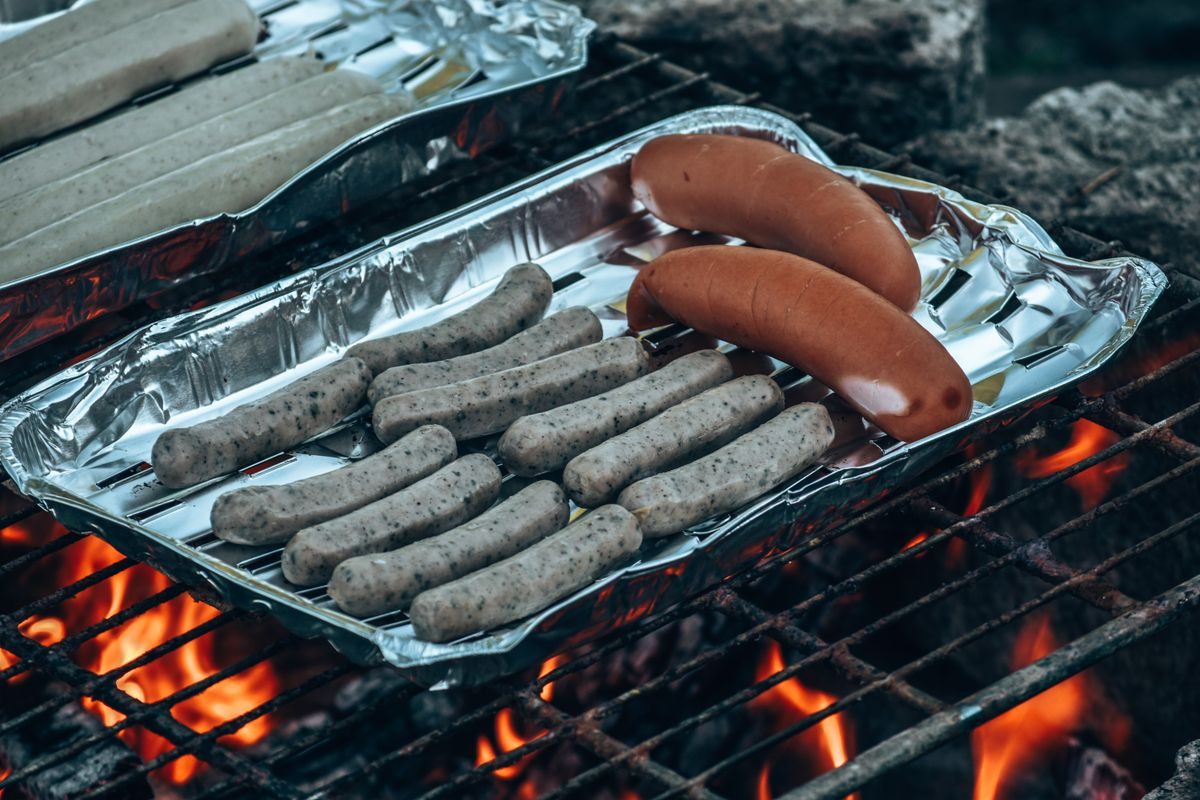
Split casings are the most common complaint about grilled bratwurst, and the fix is mostly about heat control rather than any special gadget. This guide draws on two of Weber’s published brat recipes, Beer-Simmered Brats with Cheese Sauce and Brats with Spicy Stewed Peppers (Jamie Purviance), plus the safe-temperature guidance from the USDA Food Safety and Inspection Service (FSIS). We have not cooked these ourselves; the steps below are Weber’s methods, put into our own words.
Why Sausages Split
Weber’s recipes do not go into casing science, but the approach is clear. In the simmer-first recipe, the brats sit in a pan of beer and onions over the grill, and the instruction is blunt: if the liquid starts to boil, move the pan to indirect heat to prevent splitting. Read plainly, a gentle simmer is fine and a hard boil is what Weber is guarding against. Weber’s second recipe takes the other route, searing the brats over moderate rather than fierce heat and finishing them in a pan on the cooler side of the grill.
Method One: Simmer First, Then Brown
This is the gentler of Weber’s two approaches and the one aimed squarely at avoiding splits.
- Set up for direct high heat. Weber starts at 450–550°F (roughly 230–290°C, our conversion). On a charcoal grill, it says to keep a small area free of briquettes as an indirect-heat safe zone.
- Build the simmering bath. In a large disposable foil pan, Weber combines two 12-ounce bottles of Belgian-style wheat beer or ale, two sliced red onions, a tablespoon of country-style Dijon mustard and a tablespoon of sugar, then adds six fresh bratwurst. Weber’s ingredient list specifies brats pierced several times with a fork, so that is what this version does; its other brat recipe above does not mention piercing.
- Simmer with the lid closed. Bring the pan to a simmer over direct high heat and cook about 20 minutes, turning the brats now and then, until they look evenly coloured and no longer raw. If the liquid boils, slide the pan to the indirect zone.
- Drop the heat and brown. Weber lowers the grill to medium (350–450°F, about 175–230°C) and lifts the brats out of the liquid, discarding it. The brats then go over direct medium heat for about 6 minutes, turning occasionally, until browned.
Method Two: Sear, Then Finish in a Pan
The second recipe skips the simmer and uses a two-zone medium fire (350–450°F).
- Grill six bratwurst over direct medium heat with the lid closed for about 15 minutes, turning occasionally, until lightly charred all over.
- Move them into a foil pan of softened peppers, onion and beer (Weber’s mix uses a cup of beer and two tablespoons of spicy brown mustard) and cook over indirect medium heat, lid closed, for 10 to 15 minutes.
- Weber marks the brats as fully cooked at 160°F (71°C). If the pan starts to dry out, it suggests adding a little more beer.
A separate Weber recipe using the same idea, Brats with Stewed Spicy Peppers, adds a useful turning detail: turn the brats every few minutes and swap their positions as needed for even cooking.
Safe Internal Temperatures
Whichever method you use, a food thermometer is the only reliable way to know a sausage is done. FSIS states that food should be cooked to the listed minimum internal temperature, measured with a food thermometer, before it is removed from the heat source.
- Uncooked sausages made with ground beef, pork, lamb or veal: 160°F (71°C). FSIS’s chart gives the same figure for ground meats, 160°F (71.1°C).
- Uncooked sausages made with ground turkey or chicken: 165°F (74°C, our conversion).
Check the package first. FSIS explains that sausages are either uncooked or ready-to-eat, and that cooked bratwurst sits in the cooked-sausage category alongside hot dogs. Sausages that are not ready to eat must carry safe handling instructions, and FSIS says the product should display cooking directions suited to the consumer.
What About Hot Dogs?
Hot dogs are a different case because they are already cooked. FSIS classes frankfurters as cooked and/or smoked sausages, so the goal on the grill is reheating rather than cooking through. Its hot dog guidance says people at increased risk of foodborne illness should reheat hot dogs until steaming hot before eating, because of the risk of listeriosis. The Weber recipes above cover fresh bratwurst, so we are not offering a tested hot dog method here; the safety guidance above is what we can source.
FSIS also notes that hot dogs should not sit at room temperature for more than 2 hours, or 1 hour once the temperature goes above 90°F (32°C, our conversion). That matters at a summer cookout.
Quick Checklist
- Keep the heat moderate, and slide sausages or the simmering pan to the cooler zone if the liquid boils.
- Turn regularly and move brats around so they cook evenly.
- Confirm 160°F (71°C) for beef, pork, lamb or veal sausages, and 165°F (74°C) for poultry sausages.
- Store raw sausage in the refrigerator; FSIS gives 1 to 2 days for uncooked fresh sausage.
Keep reading
- Smoked Sausage: 225°F Method and USDA Temperatures
- Grilled Hot Dogs Done Right: Char, Splits and Buns
- Smoking Meat Safely: A USDA and UK FSA Checklist
- How to Grill Corn on the Cob: Husk On or Off