
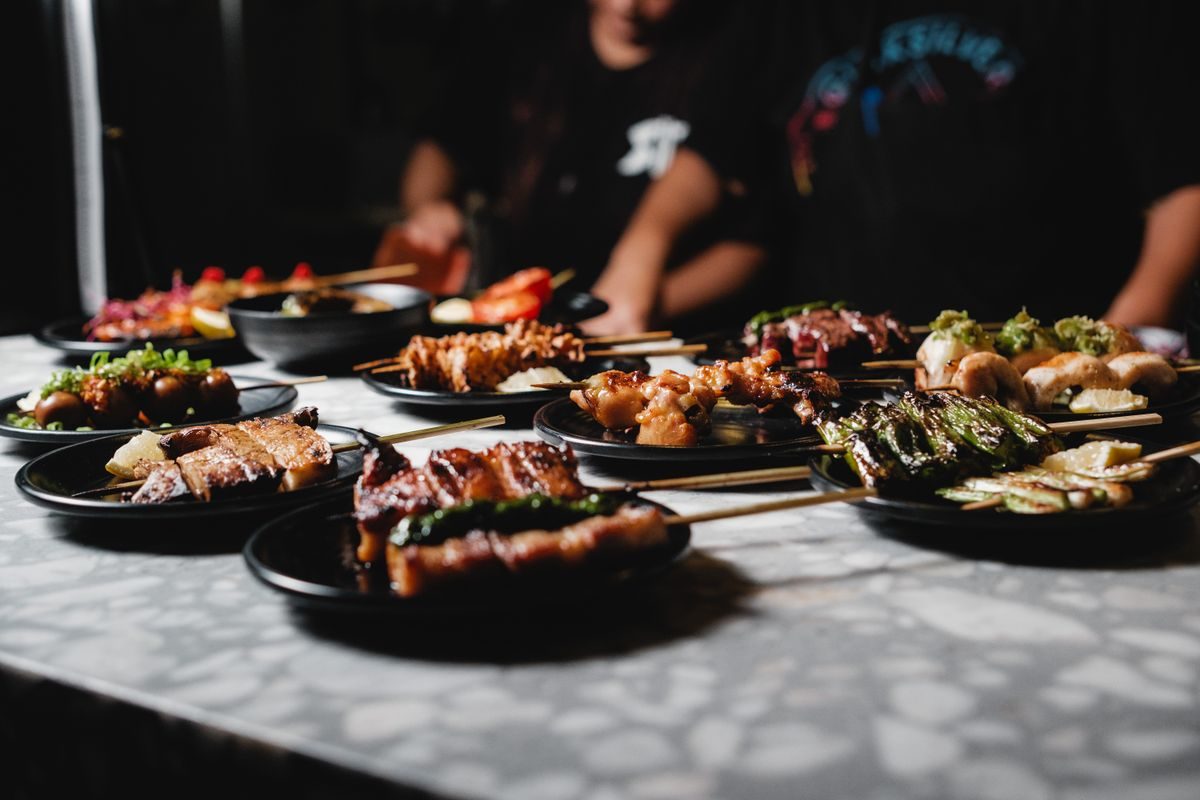
This recipe is taken directly from Just One Cookbook and its author, Namiko Hirasawa Chen — the Yakitori recipe published on justonecookbook.com. It is a chicken-and-scallion skewer (negima) brushed with a reduced soy-mirin-sake sauce, and it is a good baseline for understanding how yakitori actually works before you move it over charcoal.
Chen explains that yakitori means “grilled” (yaki) plus “chicken” (tori), and that versions of the dish have been a staple of Japanese cuisine for centuries. It is served in specialty restaurants and in izakaya, Japanese gastropubs. In Tokyo, including Shinjuku’s Yakitori Alley, she says it is typically cooked over a hot binchotan charcoal grill. Her own preferred home method is the broiler, so the timings below are for that; the grill guidance is more general.
Ingredients
Makes 12 skewers. Quantities are from the source; the gram figure for the chicken is our own conversion.
Tare (yakitori sauce)
- 1/2 cup soy sauce
- 1/2 cup mirin
- 1/4 cup sake
- 1/4 cup water
- 2 tsp brown sugar, packed and leveled off
- The green parts of 2 Tokyo negi (long green onion)
Skewers
- 1 lb (about 450 g) boneless, skinless chicken thighs, at room temperature
- The white and light green parts of the 2 Tokyo negi (or 9 green onions in total)
- Neutral oil for the rack
- Shichimi togarashi (Japanese seven spice), optional
- 10 to 12 bamboo skewers, 5 inches long, soaked in water for 30 minutes
Method
Make the tare
Combine the soy sauce, mirin, sake, water, brown sugar and negi greens in a small saucepan and bring to a boil over high heat. Reduce to low and simmer, uncovered, until the sauce is one-third of its original volume, about 30 minutes. It thickens and turns glossy as it cools, and Chen says it keeps in the fridge for 2 to 3 months once the green onion is removed.
Skewer
Cut the thighs into 1 1/4-inch (3 cm) squares and the white negi into 1 1/4-inch (3 cm) pieces. Fold each chicken slice in half and thread it on, alternating with negi and packing tightly so no bare bamboo is exposed. Each skewer holds about 3 chicken slices and 2 negi pieces.
Cook
Chen’s published method is the broiler: heat it to High, 550°F (288°C), with the rack about 8 inches (20 cm) from the element, broil 6 minutes, brush with tare and flip, broil 3 to 4 minutes, then flip, baste again and give 1 to 2 minutes more. For a grill she says to preheat to medium-high, cook both sides, and baste periodically until the chicken is fully cooked; she gives no times or temperatures for that route.
Taking It Over Charcoal
Chen’s page does not describe a full charcoal method, so this is where a second source helps. In a TASTE feature by Matt Rodbard, the experts he consulted say a standard Weber or a kamado-style ceramic grill works well. Binchotan, they say, is nearly 95 percent carbon, so it is odorless and smokeless, which suits a dish where the chicken should taste of chicken rather than wood smoke. Lower-cost compressed-wood charcoals are also mentioned as working well. The feature also notes that yakitori cooks fight flare-ups with a spray bottle of water or sake.
The same feature quotes Serious Eats editor Sho Spaeth, who says that at its simplest yakitori is chicken on a skewer, seasoned with salt and cooked with direct heat. He often skips tare altogether in favour of salt, and sometimes shichimi togarashi and lemon. In other words, the sauce here is one legitimate style, not a requirement.
Doneness and Safety
Chen’s timings are guidance only. USDA sets a minimum internal temperature of 165°F (74°C) for poultry, checked with a food thermometer. Chen also advises saving about one-third of the tare for the final baste and using it with a clean brush only after the chicken is fully cooked, to avoid cross-contamination.
Allergen Note
Soy sauce is the base of the tare. The US FDA lists soybeans among the nine major food allergens, and Chen’s recipe notes gluten-free soy sauce is available as a swap for gluten-free cooking; check every label if allergies are a concern.
Keep reading
- Just One Cookbook’s Japanese Teriyaki Sauce
- Yakiniku: Just One Cookbook’s Japanese BBQ Recipe
- Malaysian Chicken Satay and Peanut Sauce (Mandy Yin)
- Phoebe Lapine’s Gluten-Free Grilled Chicken Marinade