
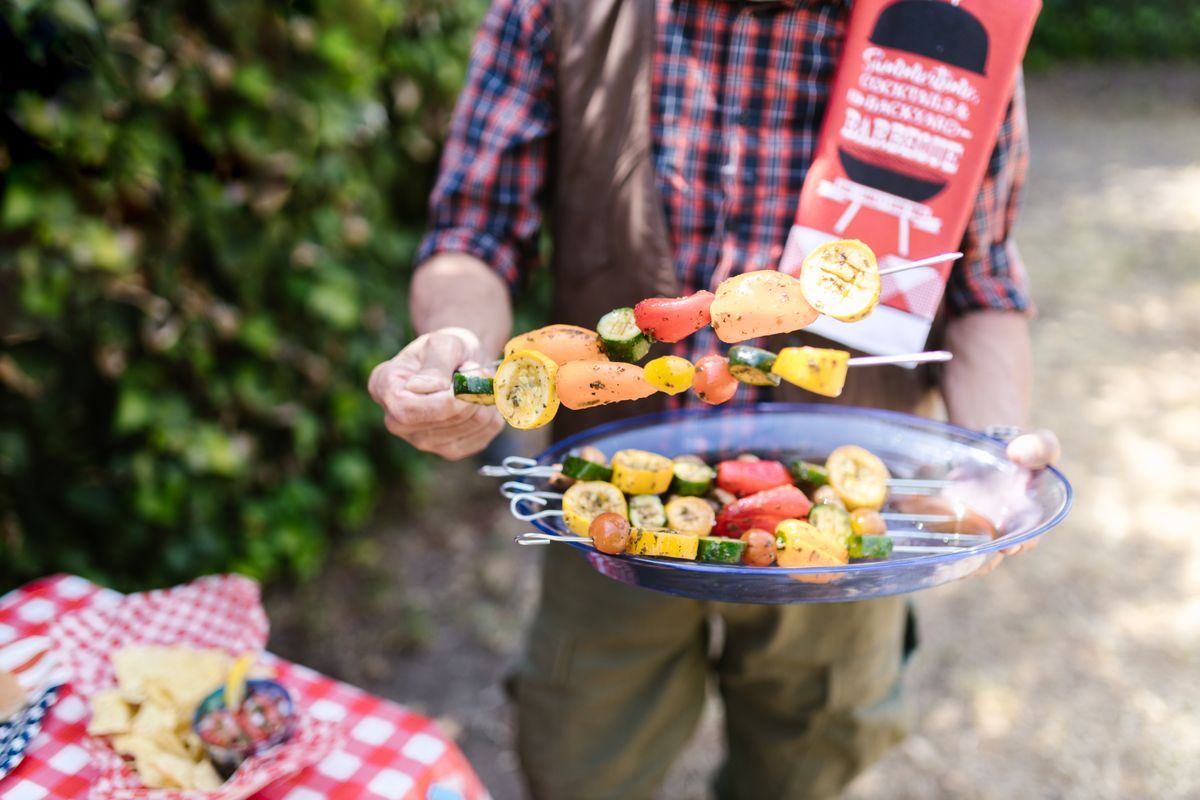
This recipe is taken directly from Weber’s official recipe library: the Mediterranean Vegetable Skewers recipe published on weber.com (Weber’s UK site, so quantities are metric). It’s a simple marinate-then-grill approach built on three vegetables. We haven’t cooked it ourselves; this is a summary of Weber’s published method, plus a comparison with a second Weber vegetable recipe that skips the skewers.
About the Diet Label
We aren’t labelling this recipe vegan or vegetarian. The ingredient list contains no meat, fish, dairy, egg or honey, but it does include balsamic and red wine vinegar, and we haven’t assessed how those are produced or fined. Check your bottles if that matters to you.
Ingredients (serves 4)
- 4 cloves garlic
- 250 ml olive oil (about 1 cup, our conversion), as printed by Weber
- 4 tablespoons balsamic vinegar
- 2 tablespoons red wine vinegar
- 2 teaspoons sea salt
- 1 teaspoon freshly ground black pepper
- 2 sprigs fresh thyme, leaves stripped
- 1 small aubergine (eggplant)
- 1 courgette (zucchini)
- 1 red pepper and 1 yellow pepper (bell peppers)
Method
- Finely grate the garlic into a bowl and stir in the oil, both vinegars, salt, pepper and thyme leaves.
- Cut the aubergine into rough 2 cm cubes (about 3/4 inch, our conversion) and the courgette into discs 2 cm thick.
- Halve the peppers lengthwise, remove stems and seeds, flatten them, and cut into irregular 2 cm squares.
- Put all the vegetables into the marinade, coat them well, cover, and refrigerate for at least one hour and up to four.
- Thread them onto skewers, alternating aubergine, courgette and pepper.
- Grill over medium direct heat, keeping the lid closed as much as you can, until tender. Weber lists 8 to 10 minutes of cooking time, with 10 minutes of prep.
- Turn the skewers only once. If they brown too fast, sear all sides first and then move them to indirect heat.
Why the Uniform Cuts Matter
Weber has you cut all three vegetables to roughly 2 cm, and then alternate them along the skewer. Matching the size of the pieces is the simplest way to help different vegetables on one skewer finish at close to the same time. The recipe doesn’t describe how each vegetable behaves, so treat “until tender” as the test and check a piece of each type before taking the skewers off.
A Second Weber Method: No Skewers
Weber’s Grilled Vegetables recipe reaches a similar result differently. It serves 6, with 15 minutes of prep and 10 minutes of direct-heat cooking, and it uses a grill pan or roasting basket rather than skewers. The ingredients are red and yellow bell peppers, 2 courgettes, 3 small spring onions, a preserved lemon, fresh coriander, olive oil, salt and pepper.
The barbecue is set for direct heat at about 220°C (roughly 428°F, our conversion). The oiled pan is preheated, the pepper strips go in first with the lid closed for 3 minutes, and then the courgettes and spring onions are added and everything cooks 7 more minutes with regular stirring. The chopped preserved lemon and coriander go in toward the end. Two things stand out compared with the skewer recipe: there is no marinade at all, and the cuts are smaller, with the courgette chopped into pieces about 1/2 cm thick.
Which you choose depends on your setup. Skewers give you neat portions and a one-turn cook, while a pan with regular stirring suits smaller pieces.
Food Safety Notes
Cooked vegetables are perishable too. USDA’s Food Safety and Inspection Service says food left out more than 2 hours, or 1 hour if temperatures are above 90°F (about 32°C, our conversion), should be discarded, and leftovers should go into shallow containers and into the refrigerator promptly. If your grill is also cooking meat or poultry, don’t use the same platter and utensils for raw and cooked items; FSIS notes that bacteria in raw juices can contaminate food that has been cooked safely.
Keep reading
- Grilled Portobello Sandwiches with Balsamic Aioli
- Grilled Lemon-Ginger Tofu Steaks on the BBQ
- Nick Nairn’s Griddled Halloumi, BBC Food’s Method
- Weber’s Grilled Eggplant with Labneh and Pomegranate